August 28, 2014

August 23, 2014
Reviving the Lost Sarasvati
"Ma Saraswati is eternal and can never really be lost, she merely hid herself from human eyes until such times as their hearts become pure enough to behold her."
The Sarasvati (also spelt Saraswati)
River is one of the main
Rigvedic rivers mentioned in ancient Sanskrit texts.
Most of its route, except for its Himalayan connection as well as those in the south to the ocean, has been well known to both Indian and
International scholars as at least some of the present day seasonal river the Ghaggar- Hakra, especially the part that passes through Haryana and Rajasthan. This is well confirmed by an overwhelming body of both ancient as well as
modern scientific evidence. However, its northern connections and tributaries are not fully located yet. Similarly, the southern connections are also not fully known. In case the river is revived these may have to be reoriented in any case because of division of India. The identification of the Vedic
Sarasvati River
with the Ghaggar-Hakra River was accepted by most
scholars as early as the 19th and early 20th century, including Christian
Lassen, Max Müller, Marc Aurel Stein, C.F. Oldham and Jane Macintosh amongst
others.
In his recent well argued and thorough study K. S. Valdiya
conclusively proves the fallacy of some modern studies that have deduced on the
basis of apparently erroneous evidence and arguments that the Saraswati did not originate in the Himalayas
and was merely a monsoonal river.(CURRENT SCIENCE, VOL. 104, NO. 1, 10 JANUARY 2013)
The Nadistuti hymn in the Rigveda (10.75) mentions the Sarasvati between the Yamuna in the east and the Sutlej in the west, and later Vedic texts like Tandya and Jaiminiya Brahmanas as well as the Mahabharata mention that the Sarasvati dried up in a desert. The goddess Sarasvati was a personification of this river. The late Rigvedic Nadistuti sukta enumerates all important rivers from the Ganges in the east up to the Indus in the west in a clear geographical order. Here (RV 10.75.5), the sequence "Ganges, Yamuna, Sarasvati, Shutudri" places the Sarasvati between the Yamuna and the Sutlej, which is consistent with the Ghaggar identification. The wide river bed (paleo-channel) of the Ghaggar river suggest that the river once flowed full of water during the great meltdown of the Himalayan Ice Age glaciers, some 10,000 years ago, and that it then continued through the entire region, in the presently dry channel of the Hakra River emptying into the Rann of Kutch. It continued to flow with reducing flow until perhaps around 1500 BC. Its peak flow may have been much earlier, thousands of years prior to that. Presently it is a seasonal monsoon river only, having been disconnected from its Himalayan source that may be the the Tons River and Baspa rivers that presently flow eastwards and westwards to merge with other rivers. During the active Indus valley phase the Sarasvati River was not just a monsoon river because it was possibly fed by tributaries from both Yamuna and Sutlej and also from the Himalayan glacial regions directly aside from the Shivaliks at a point somewhat west of the Yamuna but east of the Sutlej in the Himalayas, so as to become the mightiest of rivers of the time. This last river exit ( The Tons river) is likely to have changed its course somewhat due to seismic activity or landslides so that it began to flow into the Yamuna instead of southwards independantly dealing a blow to the Saraswati river in the dry months of the year.
It seems clear from the Rigvedic description that it is not that the Sutlej or Yamuna rivers that have moved away from Saraswati River, because those rivers too existed in ancient times but rather it is the tributaries of Saraswati that have shifted away and begun to flow into the former rivers instead of the Saraswati River. The most important of these are The Baspa that flows into the Sutllej now and the Tons that now flows into the Yamuna.
 |
| The Saraswati River probabaly begins as the Tons in the Himalayas |
The Tons river develops from its tributaries the Rupin and Supin rivers. However, in ancient times it is very likely, although this needs more research to confirm it was in all liklihood fed by the Baspa River too before tectonic shifts altered its course to instead feed the Sutlej River. The beauty of the Baspa river can still be seen high up in the Himalayas near the Tibetan border where still dwell souls of pure hearts. A look at this and one will be forced to remark - This is it, This is it, This is the river that gave birth to civilization
 |
| The Saraswati River can still be seen high in the Himalayas - The Baspa River |
Research points to the the ancient Saraswati river having had a source in the glacial waters of the Himalayas. The theory states that the Tons river became a tributary of the Yamuna a few thousand years ago following a tectonic event in the Himalayas. If this be so, the Tons once ran an independent course running south-west into Haryana where other tributaries merged into it. This river was then the Saraswati mentioned in the Vedic texts as the greatest of all Indian rivers. However, all this is a matter for further research but the fact that the Saraswati river was the mightiest of rivers of its time is not in doubt as evident from the prominent Indus valley sites dotting its course. Some scholars who say this river may have been another one in Afghanistan begin with an erroneous historical premise that Vedic Aryans originally lived in that region and later invaded the Indus valley civilization. A huge body of later evidence indicates that no such invasion ever took place but that migrations into the sub continent has been gradual and peaceful from both west and south stretching over centuries and millinnea and such migrations were peaceful ones as different groups arrived from harsher northern environs and found the fertile plains of North West India conducive to settle down. The exodus from the Indus valley was a result of climate changes and drying up of the Saraswati River.
With the disappearance of the Saraswati River, the first organized and most sustainable civilization of mankind known as the Indus valley civilization in modern times quickly disappeared from the planet. But before it vanished it gave the seeds of civilization to the world beginning with Sumeria, followed soon after by the Nile valley, Athens, Rome, Europe and the New World. What it could however not transmit was its message of love, truth and lack of greed. Each quanta of civilsation was more advanced than the one that preceded yet each quanta of civilisation was also further removed from love, truth, peace and joy. It is for this reason that the more organized human societies became, growing from these initial seeds, the more stressed and miserable they became too.
 |
| Source of the Mighty Saraswati River most appropriately referred to as Saraswati Mountain Ranges |
The source of Tons river lies in the 6,315 meters high mountain presently known as bandarpunch. It is the most major perennial Indian Himalayan rivers. In fact, it carries more water than the Yamuna itself which it now meets but did not a few thousand years ago to become the Himalayan source of the Saraswati River. It should be most rightly be recognized as Saraswati Devi Mountain just as the Nanda Devi Mountain is regarded as a personification of Parvati Devi as a mountain, rather than the less respectful kaliyug names perhaps inspired by the Europeans who have explored these mountains in recent times.
The drying up of the Sarasvati region may have been accelerated due to
natural solar cycles or due to man made causes very much like the present day
climate change. Recent studies suggest that deforestation rather than green
house gases are the major cause of climate change and this must have taken
place in the Indus valley civilization too
because of agricultural and rising human needs, eventually forcing the
civilization to abandon their cities along the Sarasvati and move eastwards
towards the greener Yamuna and Gangetic plains. Ancient humans had greener pastures to move to because much of the world was not inhabited then. Modern humans will have no such luxury because human population is already near the peak. Modern day climate control efforts may fall flat on their face if the widely held (although not universally held)assumption that greenhouse gases rather than deforestation is the cause of adverse climate changes is incorrect (See this). Since the beginning of time humans have given more credence to the most widely held belief rather than truth until it becomes too unreasonable such as the belief that the earth is flat.
A clinching evidence in favor of identifying the Ghaggar-Hakra River
as the lost Sarasvati is recent archeological evidence that traces the cities
dotting the route including the most ancient site of Bhirrana and the largest
ancient Indus valley city of Rakhigarhi
(see map here
). Although the Indus valley civilization is the name given to the ancient
civilization of the sub continent, the Sarasvati
River rather than the Indus was the centerline of this ancient
civilization and its more correct name
should have been the Sarasvati Valley Civilisation.
 | |
| Saraswati Valley Civilization ( Indus Valley Civilization) |
https://blogger.googleusercontent.com/img/b/R29vZ2xl/AVvXsEh6HXQB1kzB05x2p2SvMsLIBHUB0NecMv3SV1zHafekkPviCRHj7fb7ELWgMuQNkuq3BbQNgwOzw0PMVRzrIJCGSnvNk1umP40pHtsNOsTEADaTjwBRRUnzVX4fjfoiNh2FPrrz/s1600/ScreenShot542.jpg
In Rigveda, RV 7.95.1-2, the Sarasvati is
described as:
This stream Sarasvati with fostering current comes forth,Our sure defense, our fort of iron.As on a chariot, the flood flows on,Surpassing in majesty and might all other waters.Pure in her course from mountains to the ocean,Alone of streams Sarasvati hath listened.Thinking of wealth and the great world of creatures,She poured for Nahusa her milk and robustness.
 |
| Sushil Kumar, amongst strongest of men in the world |
It is also possible, although it remains to be investigated, that once the Tons river merged with the Yamuna river, its flow became so excessive that some it went underground to flow as an underground river under the present day Yamuna all the way to Allahabad in the east emerging as a river bottom spring and merging there at a point the Ganges and Yamuna rivers merge. Thus there may be truth to the hypothesis that the Saraswati that got lost from western India emerged at Triveni Sangam, Allahabad. Even if the hypothesis of the invisible underground river is not true, there is no doubt that the sangam is a Triveni Sangam ever since a period when the Saraswati River mixed and hid itself within the Yamuna, the two goddess sisters flowing as one.
Reviving the ancient river would involve two major tasks
1. Increasing
the flow of water at the north end of the Ghaggar river by channels connecting
to the Baspa and the Tons River through modern engineering to
restore at least some of its ancient flow.
2. A
part of this river enters modern day Pakistan it seems and therefore a new alignment
would have to be charted at this point, south-eastwards towards Ahmedabad perhaps, from
whence it may flow into the ocean as shown in the map.The precise alignment would depend on the natural topography of the area.
The attached map with this note shows a possible route for the Sarasvati
river. It is only an approximate schematic since precise topographic data is
not available to this author. However, it may offer a starting point to those
interested in reviving Ma Sarasvati River. They can iterate upon it keeping feasibility
and the ground situation in mind. Being a major project it can be developed in small phases, adding one connection at a time at its northern end while simultaneously working at its southern route to prevent it leaving the borders of India.
It may be pointed out that some of the Indira Gandhi Canal system in Rajasthan may merge in Saraswati river or become its tributary if the river is revived.
In case the Tons river is once again redirected to the Ghaggar, a feat easily implemented with help of modern engineering, as a result of this note or otherwise, it is requested that some of it must still be allowed to merge in the Yamuna ( perhaps in a fifty percent ratio) so as to preserve its flow and maintain the sanctity of the Yamuna plain as well as that of Triveni Sangam, the site of the Kumbh Mela.
It may be pointed out that some of the Indira Gandhi Canal system in Rajasthan may merge in Saraswati river or become its tributary if the river is revived.
In case the Tons river is once again redirected to the Ghaggar, a feat easily implemented with help of modern engineering, as a result of this note or otherwise, it is requested that some of it must still be allowed to merge in the Yamuna ( perhaps in a fifty percent ratio) so as to preserve its flow and maintain the sanctity of the Yamuna plain as well as that of Triveni Sangam, the site of the Kumbh Mela.
There is a belief amongst some mystics, a belief this author does not doubt due to his mystical interests aside from technical and scientific ones, that goodness, truth and prosperity began to vanish from India and the world as the waters of this river dried up and shall return only when this river is revived. One may not free oneself of substantial sin in bathing in the waters of Saraswati as one may by bathing in the waters of the Ganges because Ma Saraswati appears only when humans free of substantial sin dwell in the land, and when men free of substantial sin dwell in the world, when they stop crucifying symbols of truth and stop terrible atrocities on innocent helpless humans, even children, proclaiming proudly in unison with the richest and strongest countries of the world that it is their right to do so, a right to defend their stolen gains. Instead, when men shed substantial and obvious sin, she blesses them with substantial health and knowledge from her right hands and prosperity and peace from the left hands, beckoning all such to her gates with her sweet music"

Jai Ma Sarasvati
UPDATE MAY 2018:
A recent brief note extracting the scholarly portion of this note updated with recent references is available for viewing or downloading online at> https://www.scribd.com/document/380650060/Tracing-the-Origin-of-Saraswati-River-to-Tons-and-Baspa-Rivers
Map extracted and developed from the map at: http://commons.wikimedia.org/wiki/File:India_topo_big.jpg this document under the terms of the GNU Free Documentation License, Version 1.2
Mountain image adapted and modified from: http://en.wikipedia.org/wiki/File:Bandarpunch.jpg This work is licensed under the Creative
Commons Attribution-ShareAlike
3.0 License.
Tons
River photo, Courtesy
Ajay Bhandari, Flickr https://www.flickr.com/photos/ajayb/2636385086/ Some rights reserved as indicated at link
Baspa River Photo courtesy http://www.thehindu.com/features/metroplus/the-road-to-fun/article625123.ece A memorable walk amidst flowers, at Raksham. And, the Baspa
river. Photo: Rishad Saam Mehta
Some modifications have been effected in all images before posting here
Some modifications have been effected in all images before posting here
May 19, 2014
Human clothing colors in twenty first century
 |
| Clothing color in Europe a few centuries ago |
Ever since Eve ate that mythical apple most humans have felt the need to
wear clothes. The earliest clothing consisted of natural materials like leaves,
grasses and animal skins and these materials decided the color of clothing. However
as civilization progressed other colors were introduced in man made fabrics.
It is interesting to see what the favorite clothing colors
of modern humans is. Usually it is the colors chosen by the elite, the rich, famous and
beautiful that set the trend, and these can be ascertained quickly through a
Google search using carefully selected key words. The search showed that
favorite modern dress colors are shades of red and blue along with liberal use
of black and white too including gray in male clothing. Shades range from pastel to dark and consist of solid colors in clothing. Use of prints is rare as still common in tribal cultures. Green is used rarely and yellow or orange almost never except as
a shade of gold in some celebrity clothing. Brown to appears to be out. The fascinating results can be seen
at the following collection (click on the link) of google images
The link given above is a living link that is updated continuously by Google as new data is added.
The link given above is a living link that is updated continuously by Google as new data is added.
September 22, 2013
Indus Valley and Atlantis
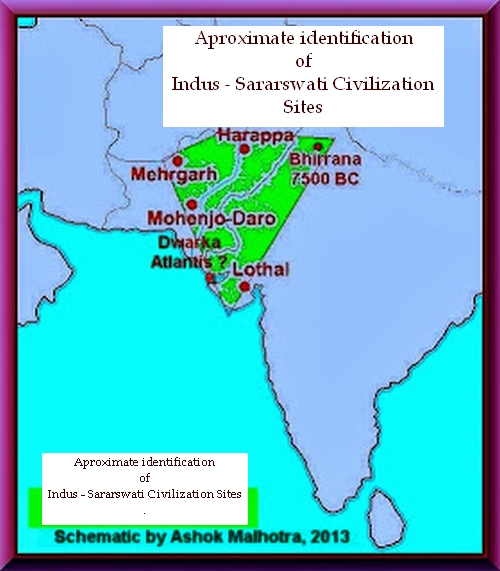 |
| Ancient civilization in the land of two rivers Saraswati and Indus known in modern times as Indus Valley often because the Saraswati River has mostly been lost since ancient times, from tectonic shifts or climate change or both |
Between three and four thousand BC three great river valley civilisations with planned urban areas sprang up in three different parts of the world - Indus Valley, Sumeria and Nile valley in Egypt. recent archeological findings at Bhirrana near Delhi push back the origins of the Indus valley civilisation to 7500 BC i.e the oldest of the three. Even Mehrgarh dates to 7000 BC showing the extent of the early Indus valley civilisation extended from Mehrgarh in the East to at least Bhirana in the west. Recent excavations in the gulf of Kambhat suggest that in the south the civilization extended up to the ocean coast. By 5500 BC all these sites had a fairly developed urban culture that predates Sumerian civilization by around two thousand years.
Rakhigarhi, located around 150 km from Delhi, housed the largest city of the Indus Valley civilisation. Even at a conservative 6,000 years old, it is 1,000 years older than Mohenjodaro, Harappa and Uruk,Sumeria. It is believed that the city was located near the now extinct Saraswati river. Therefore it does seem that urban civilisation marched from this direction first to Sumeria and later Egypt. This is especially evident because it is well known now that Sumerians were dark people of foreign origin with their own language distinct from the language of surrounding people. The contact between the Sumerian and Indus civilisation did not end with the first migration but continued well into later centuries and milleniums. A description of such later interactions can be found at http://vamadevananda.wordpress.com/2012/12/20/journal-the-river-sarawati-and-its-people/
It has also been established now with near certainty that ancient Sumerian belongs to the Austric group of languages of South Asia and that it is not a linguistic isolate. There is a separate post on that in this blog. Recent highly rigorous scientific DNA studies by support such a migration theory (http://www.plosone.org/article/info:doi/10.1371/journal.pone.0073682) from the Indian Sub-continent to ancient Mesopotamia.
The first known examples of writing may have been unearthed at an
archaeological dig in Indus valley. and Ttrident-shaped markings have been found on fragments of
pottery dating back 5500 years. According to Dr Richard Meadow of Harvard University, the director of the Harappa
Archaeological Research Project, these primitive inscriptions found on pottery
appear to pre-date all other known writing. Clay tablets containing primitive words
were uncovered in southern Egypt
at the tomb of a king named Scorpion. They were carbon-dated to 3300-3200 BC.
This is about the same time to the primitive writing
developed by the Sumerians of the Mesopotamian civilization around 3100 BC.
"It's a big question as to if we can call what we have found true
writing," he told BBC News Online, "but we have found symbols that
have similarities to what became Indus script.
(http://news.bbc.co.uk/2/hi/science/nature/334517.stm)
The summary as reported here is based on recent findings and there is a
silence about some of the new findings amongst many historians because
they upset long held and cherished views on the history of human
civilization which in the past was based on presumptions in the absence of evidence.
 |
| Spread of civilisation in the ancient world |
Scholars
differ in their opinion about the race of Indus people and more study is needed in this direction. The picture is complicated due to the presence of a racial mix that varied in time and space over the extent of the civilisation. It appears that Indus Valley Civilization had been a combination of
diverse racial elements. In fact this peaceful mixing of races is what may have spurred the inventions of early civilisation. Certain anthropological investigations and
examinations of human remains show that four racial types existed in
this civilization namely Proto-Australiod, Mediterranean, Alpinoid and
the Mongoloid. The racial diversity is the precise reason why scholars have not been able to arrive at a definite conclusion about the race of the Indus valley people. The Indus valley region was a fertile civilized land with moderate climate attractive for immigrants from all over the old world to come and settle in. Such an immigration into the sub-continent has continued until recent times and the most recent language that has been brought into the sub-continent is English. In early days days of low population density and large portions of the country yet to be discovered, immigrants would have been welcome. The Australoid type and Armenoid types appear to be a prominent strains in early samples in a ratio exceeding four is to one as in early Sumeria. The earliest contribution to urban human civilization may well have been a contribution spurred by a racial mix of Armenian origin and Australoid races. In fact a racial mix is something that has been asserted to in ancient Sanskrit literature as well such as the Mahabharata and the Vedas, with some persons being described as black and others white. It is a racial mix that continues up to modern times in South Asia.
It is possible that just as in Sumeria the language gradually changed from Sumerian Austric to Semetic Akkadian, in the Indus valley it gradually changed from an ancient Austric language similar to archaic Tamil to Indo European languages, not because of any invasion as some early western scholars presumed but becuase of how the numbers fell. Absolutely no archeological evidence of any invasion has been discovered. Some of the early historians had assumed that the advanced Indus valley civilisation disintegrated because of an invasion by barbarians from the north west and that was the reason that the region became less civilized and remained so for another thousand years. These early invasion theories have been ruled out as fanciful now although immigration in small batches appears to have been a continuous process in the region.
The disintegration of the civilization and the movement of its people towards the South,North and East appears to have been because of climatic changes and changes in the course of rivers that sustained the earlier urban civilization of Indus valley. Austric languages still continue in southern India and amongst tribal people of central India. An invasion assumption appears to be a part of western heritage, perhaps because of a history of colonisation. Even in western science fiction, whenever visits of aliens is envisaged, it is often in the form of an invasion, a concept that is viewed as strange in the East since a friendly entry is by far the more civilized thing to do as compared to war.
"Available evidence as of now in the year 2013 appears to suggest that ancient Indus Valley was the crucible in which people from far away places such as the Armenian Highlands, Catalhouyk, Jericho and other places came together with the local Australoid population as far back as 7500 BC - 3500BC to pool together their knowledge and develop the earliest innovations of human civilization such as metallurgy, agriculture, animal rearing, trading, irrigation, grain storage, writing, bricked buildings, planned urban areas and a structure for governance of large areas that included both urban centers, that were the hubs of trading, religion and governance along with rural areas as hubs of agriculture; on the fertile and climatically moderate plains of Indus valley."
The abandonment of Indus valley cities by its people, subsequent to the drying up of the region, carried seeds of civilization to other more fertile parts of the sub-continent so that by the time of Buddha around a thousand years later, Eastern India with its centers at Benares and Patna became the most developed and learned part of the sub-continent.
This is presently speculation, and more scientific evidence is awaited, but the mythical Atlantis story may have been the ancient submerged coastal city known as Dwarka in ancient Sanskrit literature. It was surrounded on all sides by water and has been described in Sanskrit texts as the most advanced part of the civilization in this region just prior to its submergence. It is on the coastal portion of Indus civilization as shown on the map. It is coastal cities that often develop the most in many parts of the world because of their greater trade interactions by both land and far away sea ports. Detailed discussion of these topics is available in other posts of this blog as well as in:
Dwarka was then the port city at a point where the Saraswati River met the OceanIt is worth noting that as per archeological findings most early sites were along the now dried up Sarasvati River (see for maps here) rather than the Indus River which was the lesser of the two rivers at the peak of this civilization. Therefore in reality the name of this earliest civilisation is Sarasvati (also spelt Saraswati) Valley civilization rather than the Indus Valley civilization.
Map adapted from http://commons.wikimedia.org/wiki/File:Spread_of_Oecumene_Mesopotamia.jpg
This file is licensed under the Creative Commons Attribution-Share
Alike 3.0 Unported license. The image has been modified before use here.
September 18, 2013
Why did the Catalhoyuk people make doors in the roof?
 |
| Catalhoyuk home witha door in the roof |
Catalhoyuk was a large Neolithic proto city settlement in southern Anatolia. It is a remarkable example
which existed from approximately 7500 BC to 5700 BC. The city was
abandoned for unknown reasons before the Bronze age commenced. It is one of the few
of the earliest known cities in the world.
The inhabitants lived in mud-brick houses that were crammed
together in an agglutinative manner. No footpaths or streets were used between
the dwellings, which were clustered in a honeycomb-like maze. Most were
accessed by holes in the ceiling, with doors reached by ladders and stairs. The
rooftops were effectively streets. The ceiling openings also served as the only
source of ventilation, allowing smoke from the houses' open hearths and ovens
to escape. Houses had plaster interiors characterized by squared-off timber
ladders or steep stairs. Each main room served for cooking and daily
activities. The main rooms contained raised platforms that may have been used
for a range of domestic activities. Side rooms were used as storage, and were
accessed through low openings from main rooms. Although no identifiable temples
have been found, the graves, murals, and figurines suggest that the people of Catalhoyuk
had a religion rich in symbols. Rooms with concentrations of these items may
have been temples. The inhabitants were worshipers of the mother goddess. In
upper levels of the site, it becomes apparent that the people gaining skills in
agriculture and the domestication of animals and fruit were harvested from
trees in the surrounding hills. However, hunting continued to be a major source
of food for the community. Pottery and tools appear to have been major
industries Tools were probably both used and also traded. This is where the
oldest pottery known from Anatolia has been
found. The oldest pottery was fired, unpainted and unglazed and had a very
simple bag shaped form.
A question that shall trouble a modern observer about this
civilization is the use of a home with a very difficult door opening in the
roof rather than on the side that is far more convenient, safer from the
elements and intruders and easier to construct. What could be the reason for
such an opening?
One possibility is that these dwelling were made by a people
who lived in pits dug inside the earth prior to making such homes. In pit homes,
precisely this type of roof openings are required. The question then arises –
are there any examples of pit dwelling from around the time? The answer is yes
and this takes us to the Pre Harappan civilization in North-west India. Bhirrana is a small village located in
in the Indian state of Haryana. It belongs to the Indus Valley Civilisation
dating from around 7500 BC too. The site is situated about
220 km to the northwest of New
Delhi.
The Bhirrana excavations have revealed the remains of the Harappan culture right from
its nascent stage, i.e. Hakra Wares Culture to a full-fledged Mature Harappan
city. Prior to the excavation of Bhirrana, no Hakra Wares culture, predating the
Early Harappan had been exposed in any Indian site. For the first time, the
remains of this culture have been exposed at Bhirrana. This culture is
characterised by structures in the form of subterranean dwelling pits, cut into
the natural soil. The walls and floor of these pits were plastered with the
yellowish alluvium of the Saraswati valley. The artefacts of this period
comprised a copper bangle, a copper arrowhead, bangles of terracotta, beads of
carnelian, lapis lazuli, bone point, stone saddle etc.. The
pottery is very rich and like their Anatolian contemporaries these
early pre Harappans too were worshipers of Mother Goddess. A connection
between and a common root of both these ancient people is very possible.
Image from:
http://en.wikipedia.org/wiki/File:Catal_H%C3%BCy%C3%BCk_Restoration_B.jpg
September 16, 2013
Sumerian not a Linguistic Isolate but an Austric Language - Archaic Tamil

Some seven years ago when I wrote a blog post (and also an ezine article)on the Sumerian language, describing why I thought that it was not a linguistic isolate but belonged to the Austric group of languages, some linguistic historians scoffed at the suggestion. It seems they were so seeped in existing theories that they did not want to open their mind to new thoughts as is common in many areas of knowledge since ancient times. The old post is here
Since this post several new studies have emerged that have
described the close similarities between Sumerian and Archaic Tamil. The modern
form of that language is still spoken by millions in southern India and its
archaic version is well documented. The Similarities between Sumerian and
Archaic Tamil are not just ephemeral but clear. Not just words are similar but
entire sentences and one would have to be blind not to see that both
languages belong to a common group. There are several references and
discussions on it on the net now that an interested reader can find for example,
http://www.araichchi.com/Sumeria/Sumeria_Linguistics.html
An
older study by Muttarayan has provided
hundreds of lexical correspondences and other linguistic data supporting the
family relationship between Sumerian and Dravidian languages.(Muttarayan, K. L., J. Tamil Stud., 1975, 7, 41–61.)Recently this author has discovered that there are several older studies comparing Tamil and Sumerian that have been ignored by the main stream scholars. There is a need now for a rigorous compilation of all these older works into a comprehensive comparison.
Tamil, especially Archaic Tamil although classified in a different Dravid group is either a more developed subset or has a close relationship with the Austric/Australoid group of languages as different from the Indo-European group.. Although upon further reflection some of the statements of the original article need revision however its central assertion that Sumerian is not an isolated language but rather belongs to the Austric group of languages appears to be verified. it may be pointed out that blog posts are not written as carefully as scholarly articles but that does not mean that none of them contain any valuable information. They can serve to articulate an idea that may later be pursued with the thoroughness and referencing required for a peer reviewed journal article.
Thus the original deduction of this author stands vindicated that ancient Sumerian was not an isolated language but rather belonged to the Austric group of languages.This language has been identified as Archaic Tamil
August 30, 2013
Men came from Mars and Women from Venus

There were reports in the media recently that conditions
were conducive for creation of life on Mars at one time and that life may
have come to earth from that planet. I was reminded of the old adage that Men
are from mars and the Women from Venus. However, it is not necessary to limit
one’s imagination to just Mars or Venus once one has read and understood the
theory of Panspermia (or its modification Pansmeria) described in several posts of this blog. The posts
describe in detail how it is possible for bacteria in hibernation to arrive on
Earth from virtually any part of the universe, from far away galaxies and even
other galaxies over millions and billions of years. Within these bacteria are
the genetic codes for all life forms that exist on earth and those that are yet
to appear. Bacteria even carry the gene of advanced life forms on a planet because they can be infected by viruses carrying break away genes from advanced life forms.
The genetic make up of bacteria is such as can be modified easily, and once modified replicate as they multiply by duplication rather than sexual reproduction that tends to eliminate such modification during reproduction. It does seem that it is at the level of bacteria and viruses that creation of new life forms takes place and it is an ongoing process, with most new variation rejected but few becoming a part of the genetic pool of life in the universe. It is only when a gene is integrated in a higher life form that it can be perpetuated near endlessly because of a continuous rejection of erroneous mutations through the process of sexual reproduction
Subscribe to:
Posts (Atom)
Spaceships of God
W e now know that the sun will eventually start to cool down, expand and explode. Mankind hopes that well before that it will escape f...

-
The Elamo-Dravidian language family is a language family that links Dravidian languages of India to the extinct Elamite language...
-
 Ancient civilization in the land of two rivers Saraswati and Indus known in modern times as Indus Valley often because the Saraswati Rive...
 -
 A lthough Egyptian civilisation is at least seven thousand years old, a unified Egyptian civilisation with urban centers and a central a...
 -
 Stonehenge Many have wondered who the builders of Stonehenge in England were. Were they local persons or were they migrants from...
 -
 Plato by Raphael Thinking and motivations, both good and destructive, in society develops over centuries from its experiences. Si...
 -
"Ma Saraswati is eternal and can never really be lost, she merely hid herself from human eyes until such times as ...
-
Catalhoyuk home witha door in the roof Catalhoyuk was a large Neolithic proto city settlement in southern Anatolia. It is a remark...
-
 15th of September 2006 As spoken in the voice of an Alien from a more advanced planet in a galaxy far far away: A t one time you tho...
 -
 It is of considerable interest to trace where the ancient Sumerians emerged from because of their primary contribution to human civilizat...


