Possible Tamil Origin
 |
| Excavated ruins of a swimming pool from the Indus Valley Civilization |
Based on available archeological evidence, the beginnings of
organized human civilization have been traced to Sumerian and Indus Valley
civilizations. However scholars have postulated that there is a possibility
that both civilizations were due to the influence of a yet older undiscovered civilization
that may have its beginning in the last ice age. How can a civilization be lost without leaving any trace?
The answer lies beneath the sea. Coastal regions of present day continents
submerged in the ocean as the last ice age receded and it is here that an
ancient civilization may have thrived. Such a civilization would have to be
older than 5500 BP, at which time it submerged and the people that escaped from
it could then be responsible for initiating the Sumerian civilization after the
submergence as well as the the Indus
civilization.
Such submergence is in fact a part of Sumerian written
records and is also a part of the prehistorical traditions of many other ancient
civilizations including the ancient Greeks (Atlantis) and Tamils of Southern India. Prehistoric knowledge is a
part of folk lore and has undoubtedly undergone modifications and distortions with
time. However, there is now strong
scientific evidence for submergence of coastal regions in various parts of the world as well as low lying islands. Sumerian written records attest to it. The Sumerians
described their ancient land as Dilmun/Tilmun that got submerged with
a flood/tsunami. Nevertheless their records show that they continued to trade
with Dilmun later by sea. The view of this
author is that as ancient Tilmun got submerged other new areas were
named after it. In archaic Tamil this name simply implies the Land of Good Living just as Ur in Tamil simply means a town and any town is an Ur (in modern usage PUR)
Submergence due to
rise of Sea levels
During the last ice age sea level was at least 120 m lower
than it is today exposing much more area on the continents. Many changes took
place as sea level rose including the submergence of coastal regions. An
interval of rapid sea level rise was first identified by a hiatus in
coral growth in the Caribbean about 7600 years
ago. Southampton researchers have estimated that sea-level rose by an average
of about 1 meter per century at the end of the last Ice Age, interrupted by
rapid 'jumps' during which it rose by up to 2.5 meters per century. Global sea
level rose by a total of more than 120 meters as the vast ice sheets of the
last Ice Age melted back. This melt-back lasted from about 19,000 to about 6,000
years ago, meaning that the average rate of sea-level rise was roughly 1 meter
per century.
(
http://www.sciencedaily.com/releases/2010/12/101201120605.htm)
Lost Civilization
If it is assumed for a moment that an older civilization
existed that preceded Sumerian and Indus civilizations, the question that
needs to be answered is, who were these ancient people and what tribe or race
did they belong too? Where were their major ancient cities? It is has now been established over the last decade beginning with a study by the present author that Sumerian language
was identical to ancient Tamil, Archaic Tamil (
see here) and that Sumerians were in the
main dark people similar to the Tamil Australoid race. In Sumer they mixed with person of Semitic and
Aryan origin from the North, whereas the mixing in Indus
was with Aryan Indo-European speaking people.
The Tamil people presently inhabit southern India and it is possible that in
the past they may have inhabited the region up to the southern limits of the
Indus civilization in the south along the Indian Ocean coast i.e. present day
Dwarka, the mouth of the Saraswati River and westwards towards the mouth of Indus valley. According to N. Parameswaran,
quoting from ancient Tamil literary tradition,
(
http://www.tamilguardian.com/article.asp?articleid=256)
According to the Kumari Kandam tradition, over a period
of about just 11,000 years (beginning around 9000BC), the Pandyans, a
historical dynasty of Tamil kings, formed three Tamil Sangams, in order to
foster among their subjects the love of knowledge, literature and poetry.
The first Sangam was head-quartered in a city named
Then-madurai it was patronised by a succession of eighty-nine kings and survived
for an unbroken period of 4,400 years during which time it approved an immense
collection of poems and literature. At the end of that golden age, the First
Sangam was destroyed when a deluge arose and Then-Madurai itself was swallowed
by the sea along with large parts of the land area of Kumari Kandam.
However, the survivors, saving some of the books, were able to relocate further
north. They established a Second Sangam in a city called Kavatapuram which
lasted 3,700 years. The same fate befell this city as well, when it too was
swallowed by the sea and lost forever all its works with the sole exception of
the Tolkappiyam, a work on Tamil grammar. Following the inundation of
Kavatapuram, the survivors once again relocated The Third Sangam lasted for a
period of 1850 years and most scholars agree that that Sangam terminated around
350 AD. As observed by Prof. (Dr) M.
Sunderam, “The tradition of the loss of a vast continent by deluge of the sea
is too strong in the ancient Tamil classics to be ignored by any serious type
of inquiry.”
It is interesting to note that gradual
submergence of cities is in agreement with gradual rise of sea levels that
lasted up to around six thousand years ago as per the South Hampton study.. Tamils from the south
appear to have migrated north to the southern tip of what later became the Indus
valley and Saraswati valley civilizations. Their
grand coastal cities were later eroded as the sea rose. These people who settled
coastal regions over the years were responsible for the creation of an ancient
civilization that preceded both the Indus
valley and Sumerian civilizations.
Locating the Lost Civilization
The question then is, can the ancient submerged civilization
be located? Is it off the Indian coast somewhere? It may be mentioned that
submergence took place thousands of years ago and except for the most prominent
of structures much would have been buried and destroyed by the oceans. Even
ancient ship wrecks take centuries to locate and therefore a submergence that
took place more than five thousands years ago would be even more difficult to
locate. However what appear to be traces of ancient structures have been found
of the present day Dwarka. This latter is likely to be a possible location
from where Sumerians originated because of its proximity to Sumeria, both
by land and sea and this area is perhaps also the Atlantis of Plato.
The megaliths of ancient Dwarka are in fact found submerged just offshore from modern Dwarka, and the huge
stone walls built of megalithic blocks which had been interlocked with chiseled
L-shaped dovetails are characteristic of the Indus Civilization. The Gulfs of
Cambay and Kutch, just south of Dwarka, also
hold submerged megalithic Indus Civilization structures that were covered by
the ocean at the melting of the Ice Age. The ruins, discovered in 2000 and
investigated with acoustic techniques, are known as the Gulf of Khambat Cultural
Complex. They’re 131 feet beneath the surface.
One of the artifacts dredged up by scientists was dated around 7500 BCE, which
could support the theories that it is, in fact ancient Dwarka described in
Sanskrit later that also described its sudden drowning. The ruins below the Gulf of Cambay go back at least nine thousand years. However a full scientific validation of these findings await further excavations made difficult because of the underwater nature of the site.
(
http://www.unacknowledged.info/dwarka-mythical-city-found-water/)
Further ruins have been found somewhat a little to the south
off the Konkan coast.
In what could turn out to be a major discovery; researchers have found a
wall-like structure, which is 24km long, 2.7m in height, and around 2.5m in
width. The structure shows uniformity in construction. “The structure is not
continuous from Shrivardhan to Raigad, but it is uniform. It has been found 3m
below the present sea level. Considering the uniformity of the structure, it is
obvious that the structure is man-made,” said Dr Ashok Marathe, department of
archaeology, Deccan College Postgraduate and Research Institute, Pune.
This joint expedition carried out by Deccan College,
Pune and Department of Science and Technology, Central Government, has been in
progress since 2005. “We were actually studying the impacts of tsunami and
earthquake on western coast when we first found this structure in Valneshwar,”
said Marathe. However, the age of the structure was decided on the basis of sea
level mapping. “There have been exhaustive studies about the sea water coming
inside the land. Based on calculations, experts from National Institute of
Oceanography (NIO) pegged the age of the wall at around 6,000 BC,” Marathe
informed.
Present day Tamil
Areas
The majority of Tamil speaking people presently live in southern India, some
distance from the western coast of Dwarka, but their present location is not
likely to be the location for the ancient submerged civilization because of two
reasons, they are further away from ancient Sumeria and also because one would
have expected the remains of other ancient civilizations in the land areas
nearby. Such areas exist north of the western coast near Dwarka as the remains
of the Indus valley civilization. The current
language spoken in these areas are Indo European languages rather than Tamil
derivatives. However, something like that happened in Sumeria as well where the
Akkadian language of the majority gradually replaced the old Sumerian language.
Further south too in present day Kerala,
the old Tamil was heavily influenced by Indo-European Sanskrit so as to become
a new language.
However one might expect that if a majority group of Tamil speakers live in
relative isolation somewhere in the North-West part of Indian sub-continent, the
Tamil language may have survived with them until today. Such a community does
in fact exist in the Baluchistan region that
is dotted with communities that have lived in relative isolation from each
other since ancient times. Indo- European Baluch are a war-like people. As the
last to arrive of the major ethnic groups of Pakistan
they were faced with the need to displace the peoples already settled in Baluchistan. Some they more or less successfully
subjugated or assimilated, like the Meds of Makran and other now subordinate
groups. From others they faced a greater challenge, notably from the Brahui
tribes occupying the hills around Kalat. The origins of the Brahuis are even
more puzzling than those of the Baluch, for their language is not Indo-European
at all, but belongs to the same Dravidian family as Tamil and the other
languages of south India spoken over a thousand miles away.
Contrary to earlier speculation about recent
migrations, linguistic and genetic analyses show that they have been separated
from other Dravidian speakers for at least several thousand years. Aside from this
exception, it is only in areas far removed from Indo-European influence, the
present day Tamil Nadu and neighboring areas that the modern forms of Archaic Tamil mainly survives.
Alternative Possibilities
The present discussion has been based on the fact that the
Sumerian language has been identified as an older form of Archaic Tamil. While there appears to be little
doubt to the conclusion that Sumerians were speakers of Archaic Tamil, there
are some other implicit assumptions in the present discussion that need further
verification. These are:
- That
the Tamil speaking people have been the inhabitants of Southern India ever
since the last ice age, but not of North India
that was predominantly Indo- European speaking area at that time even.
There
is also little to doubt in the fact that while some from the Australoid races have remained
as forest tribes even up to present times, some branches evolved to develop
highly advanced civilizations. A similar feat by a branch of the Australoid
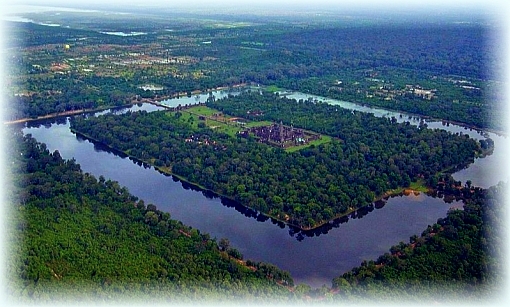
people has also been performed later in Angkor Vat of Cambodia in historic
times. Small amounts of genetic and
evolutionary changes in groups of humans can make a vast difference and
there are very many examples of that amongst humans and animals seeing
that genetically even a chimp is 99 percent human. Another example of
that is those at Athens who developed a very advanced civilization at a
time when people of similar race were still up to nothing of great civilizational significance not very far west of them. However there are two other possibilities that need to be
debated and explored further:
- That
the movement of language and civilization was not from the Indian western
or southern coastal regions to Sumer but the other way around i.e. some
Sumerians moved to the Indian coastal regions with their language and
dominance and that while archaic Tamil was overtaken by Semitic languages
in Mesopotamia, the reverse happened in Southern India i.e. the local
languages were replaced by archaic Tamil. OR,
- That
all of India in the Indus valley times including southern India was predominantly
Tamil speaking prior to 2000 BC and that some time after 2000 BC the
language of North India was overtaken by Indo European due to increasing
migrations from central Asia, whereas the Tamil language survived in
Southern India. This does not imply any violent incursion by an Indo European people into North Western India but a continuation of a largely peaceful process of migrations that took place in the old world in ancient times. It must be remembered that at that time the total human population was much smaller and much of the earth still uninhabited and there was no such thing as immigration control in those times.
Of the two additional possibilities mentioned here the
second is more plausible than the first given the recent archeological
discoveries in Indus valley that push its time to more than a thousand years
before the Sumerian civilization suggesting that the movement of civilization
could have only been from the direction of Indus to Sumer and not the other way
around. Added to that is the historical evidence that the Sumerians were foreign
migrants with a foreign language of non- Semitic origin, not similar to any language of the region, leading scholars to conclude hastily that Sumerian is an isolated language because it was unlike Semetic or Indo-European languages. They could not have come from another star system, nor were they a people barely past tongue clicking, and this simple logic is what had led this author to explore the matter further more than seven years ago and arrive at the conclusion that their language belonged to yet another group of Austric origins. They had moved into Sumer sometime before 3000 BC, bringing with them technology and tales of an ancient great civilization from where they came.
See also for Tamil - Sumerian links: http://arutkural.tripod.com/sumstudies/dilmun-tillai-en.htm