Origin of Egyptian Civilization

Although Egyptian civilisation is at least seven thousand years old, a unified Egyptian civilisation with urban centers and a central authority emerged in Egypt with the coming of the Pharaohs beginning with the scorpion king Narmer/ Nirmer/ Naram- Ara of Sumerian origin. The Scorpion gods were warrior gods in Sumeria and it is a mark of respect to regard a great warrior king as one.
This movement into the Nile Valley may have coincided with the end of the Uruk period that in turn coincided with the Piora oscillation, a dry period that began in c. 3200 BCE and ended in 2900 BCE that marked the end of a long wetter, warmer climate period from about 9,000 to 5,000 years ago, called the Holocene climatic optimum.
A prehistoric flint knife, with a handle carved from the tooth of a hippopotamus, in the possession of Louvre and found at Gebel el Arak near Nag Hamâdi depicts a scene from the conquest. On one side of the handle is a battle-scene including some remarkable representations of ancient boats. Many of the warriors are nude with the exception of a loin girdle, but, while one set of combatants have shaven heads or short hair, the others have abundant locks falling in a thick mass upon the shoulder. The nude warriors are obviously of local African origin. It displays the wisdom of the conquerors in utilizing locals for their campaigns. On the other face of the handle is carved a hunting scene. In the upper field is a remarkable group, consisting of a personage struggling with two lions arranged symmetrically. The rest of the composition is not very unlike other examples of prehistoric Egyptian carving in low relief, but here attitude, figure, and clothing are un-Egyptian. The hero wears a turban on his abundant hair, and a full and rounded beard descends upon his breast. A long garment clothes him from the waist and falls below the knees, his muscular calves ending in the claws of a bird of prey. There is no doubt that the heroic personage is represented in the familiar attitude of the Babylonian hero Gilgamesh struggling with lions, a favorite subject of early Sumerian and Babylonian seals. His garment is Sumerian rather than Egyptian. The design itself is unmistakably of Mesopotamian origin. There was no physical barrier to the use of the river-route from Mesopotamia into Syria and of the tracks thence southward along the land bridge to the Nile's delta.
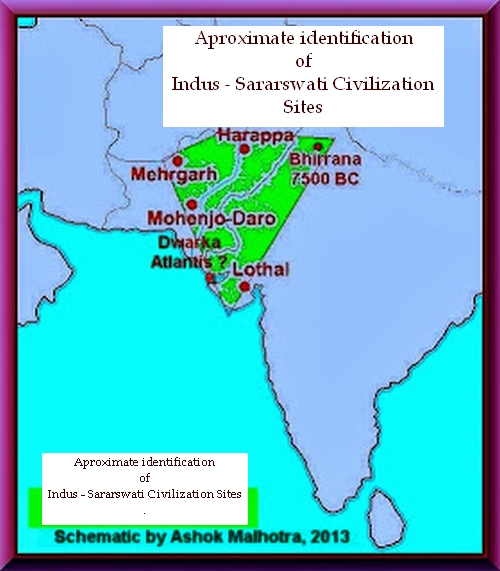
 After the conquest Nirmer appears to have returned to to his homeland leaving his son Menes in charge of the new kingdom with assistance of Priests and soldiers. Menes unified the scattered communities of the entire Nile Valley. There he established the First Egyptian Dynasty with an Uruk period Sumerian civilization. The unified state led to the development of writing, the start of large scale construction and the venturing out from the Nile Valley to trade. The most remarkable evidence of cultural connection is shown in the architecture of Early Dynastic tombs of Egypt and Mesopotamian seal-impressions showing exactly similar buildings. A problem that early Sumerian ruling class faced upon arrival in Egypt was the different, even contrary religious beliefs. Egyptians glorified the floods whereas the Sumerian dreaded it because of their religious records of the deluge that had originally flooded their homeland and beautiful cities perhaps on the western coast of India leading to their exodus. However the Sumerians soon assimilated everything useful they found in the new lands and thus developed their culture even further.
Unlike the colonists of eighteenth century the Sumerians arrived in any new territory with the intention of making it their home and progressed from strength to strength as they marched westwards. However the Nile valley was the limit of their expansion since their were no other great rivers flowing through vast arid plains to the west of the Nile.
Who was the Frist Egyptian Pharao

There is considerable confusion amongst scholars as to who the first
Egyptian Pharaoh was, who ruled over all of Egypt
from his capital at Memphis.
According to the kings list made a thousand years after his time, his name was
Men, Meni or Mena. The reason for using different vowels is because in Egyptian
writing vowels are not written (as at times in Arabic) and these have to be
guessed. The Greek historian Mantheo of 200 BC who was known for developing
meticulous historical records, called him Menes in Greek. That is the most
popular way Mene is mentioned in modern literature. This pharaoh is the
legendary king that came from the town of Tinis in Upper Egypt and took over
Lower Egypt (the North) by force. He then became the first king over the whole
country and founded a new capital for united Egypt
- Memphis, just
where the two states bordered on each other. According to archaeological dating
this was around 3200 BC. For thousands of years, King Menes was thought to be
the first king of Egypt.
Ancient Egyptian records clearly identify him as the first king of the first
dynasty.
However since then much else has been discovered by archeological findings
that have led to some confusion. In the last decade of the 1900s the old royal
tombs in Abydos
were re-excavated. Two seal impressions were found from the tombs of Den and
Qaa, the fifth and eighth ruler of the first dynasty. The motif was a line of
kings in a successive order, and both had Narmer as the founder of the first
dynasty. This record should be an authentic one since it comes from a time much
before Menthos or even the Kings list. Most of all, it was prepared by the
descendents of Narmer himself. Some scholars postulated that Menes and Narmer
may be the same person. Was it really so? The matter requires further enquiry.
The seal impressions of Den and Qaa describe the kings of the first dynasty as:
Narmer,
Aha,
Djer,
Djet,
Den
Thus it is clear that Aha was the son and successor of Narmer. King Aha, on
the other hand, was the first pharaoh who built monuments of substance over the
whole country, and his large tomb constructions (with buried retainers for the
first time) were in dimensions that far overshadowed his predecessors including
Narmer his father. He has also left a written sign interpreted as the name
"Mene" written beside his ordinary name on one occasion. This at once
indicates that he is the same as king Mene (or its Greek form Menes). Thus
available evidence indicates that it was Aha and Menes who were one and the
same person and not Narmer and Menes.
Confusion may have arisen in interpreting historic records because both
Narmer (Also known popularly as the scorpion King) and Menes together united
Upper and Lower Egypt. The credit of
unification would go to Narmer as the father and this is indeed supported by a
later archeological find the -Narmer Palette. Menes or Aha on the other hand
was the first king to build substantial monuments in Egypt and may have been regarded by
many as the first real Pharaoh of Egypt, thus leading to the confusion.
Narmer's Palette found at the temple
of Hierakonpolis shows
that behind the king is his sandal-bearer, a high dignitary, possibly his son,
who is identified by a rosette (seven petalled) the divine or royal emblem.
This son is likely to be the legendary Menes who accompanied Narmer in the
conquests. Both may have ruled different parts of Egypt
together for a period after the conquest with the younger Menes focusing more
on the building of a new Capital at Memphis.
Thus it may be concluded that Narmer was the first king of united Egypt and his son Menes the first king that
ruled over all of Egypt from
Memphis. After
the establishment of dynastic rule in Egypt,
the villages of Egypt
were transformed from members of a loosely organized society in which
autonomous chieftains and merchants played the most significant roles, to one
under the centralized control of an imperial king.
The kings list of later dynasties appears to have focused on listing the
kings of Memphis
and thus correctly listed Menes as the first king to rule from that capital,
ignoring the father who affected the unification. The second dynasty of Egypt had
different roots from the first one. When they came to power they replaced the
falcon symbol of the first dynasty by the symbol of a dog. The descendents of
Narmer himself would not however ignore their ancestor in developing their own
list of kings and listed Narmer as the first king.
Published earlier by author at Article Source:
http://EzineArticles.com/314530



Comments
This is so interesting: In spite of contrary religious beliefs, Sumerians moved westward. Your description of Sumerians in mind, I wonder how they reacted to floods and the behaviors of Egyptians. They seemed to learn a lot from the Egyptians.
It was also described that diring the last mini ice age many human groups were forved to move South towards ancient Tamil lands and it was this interaction that gave birth to human civilisation, later after the iceage receded these amalgamated groups began their northward and westward again with their language